
Pastor Raul Ries: The Traveling Vietnam War Memorial
Photos by Carrie Rosema, Sadie Lyda, and Steve Shambeck
This story was first published in the Summer 2012 issue of Calvary Chapel Magazine, Issue 52.
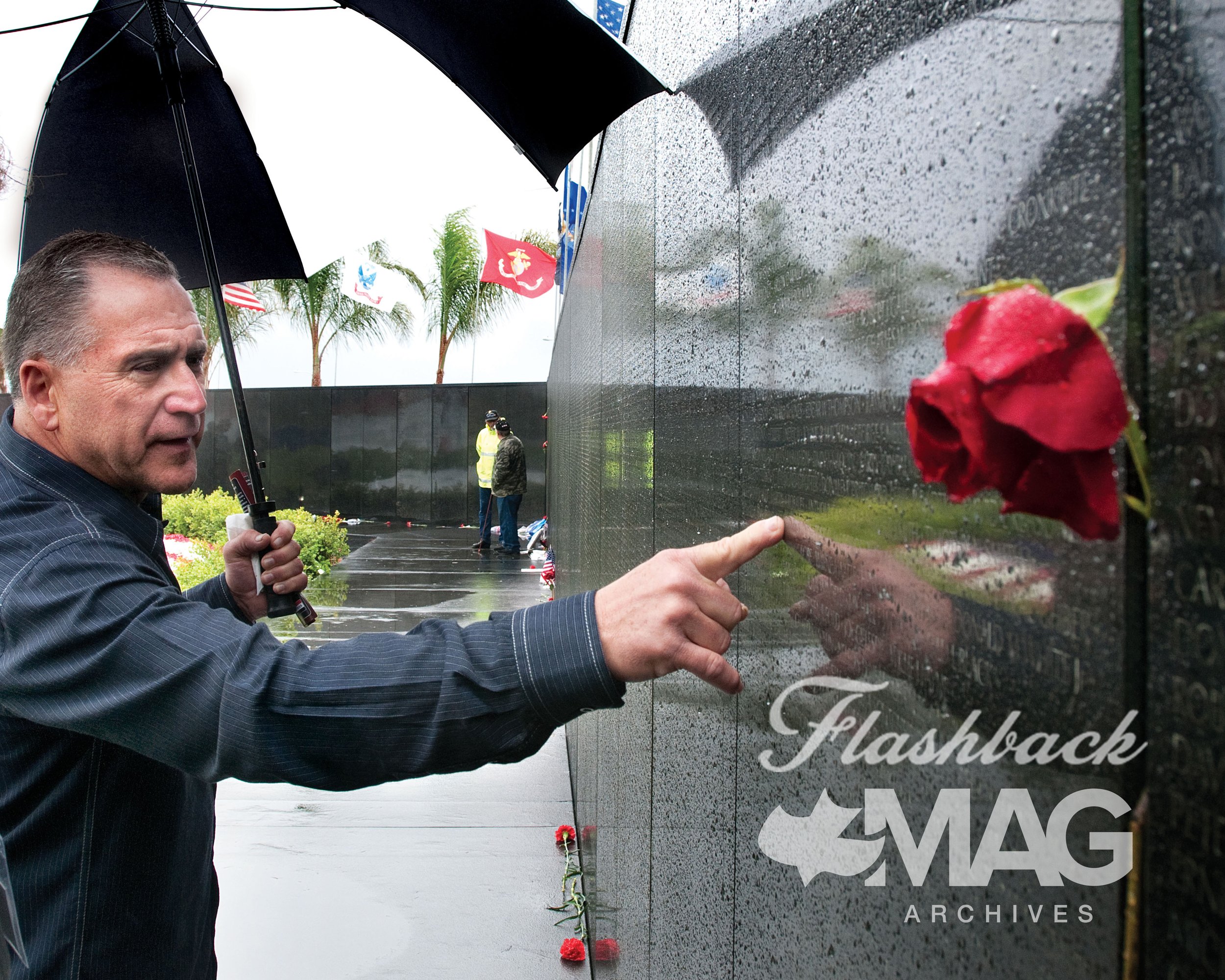
Pastor Raul of CC Golden Springs (CCGS), CA, pays respects at the wall. Raul touches the name of Kenneth Stutes, a close friend who died while they served together in USMC company Alpha 1/7. Photo by Sadie Lyda
As the film Taking the Hill ended and the lights came up, a veteran sat stunned in his seat. The pain from Vietnam he had worked hard to bury had been unearthed during the last 54 minutes. A phrase uttered by Raul Ries halfway through the movie echoed in his head: “I didn’t think God could forgive me.” Yet Pastor Raul’s story, which opened with torment this man understood, ended with hope he couldn’t imagine. As the auditorium slowly emptied, the man gathered his courage and, with two fellow veterans, approached Taking the Hill’s campaign coordinator. As they discussed the film, he began to say, “Raul’s words really hit me: ‘I didn’t think God could for-’”
Before finishing the word, he began choking on tears. In his head, he was back in Vietnam. A woman was walking toward him out of rice paddies, carrying a basket. She was crying, shouting, and getting close when she dropped the basket and a gun spilled out. “We had to kill her,” he sobbed. “They told us to be always on guard. We had to kill her.”
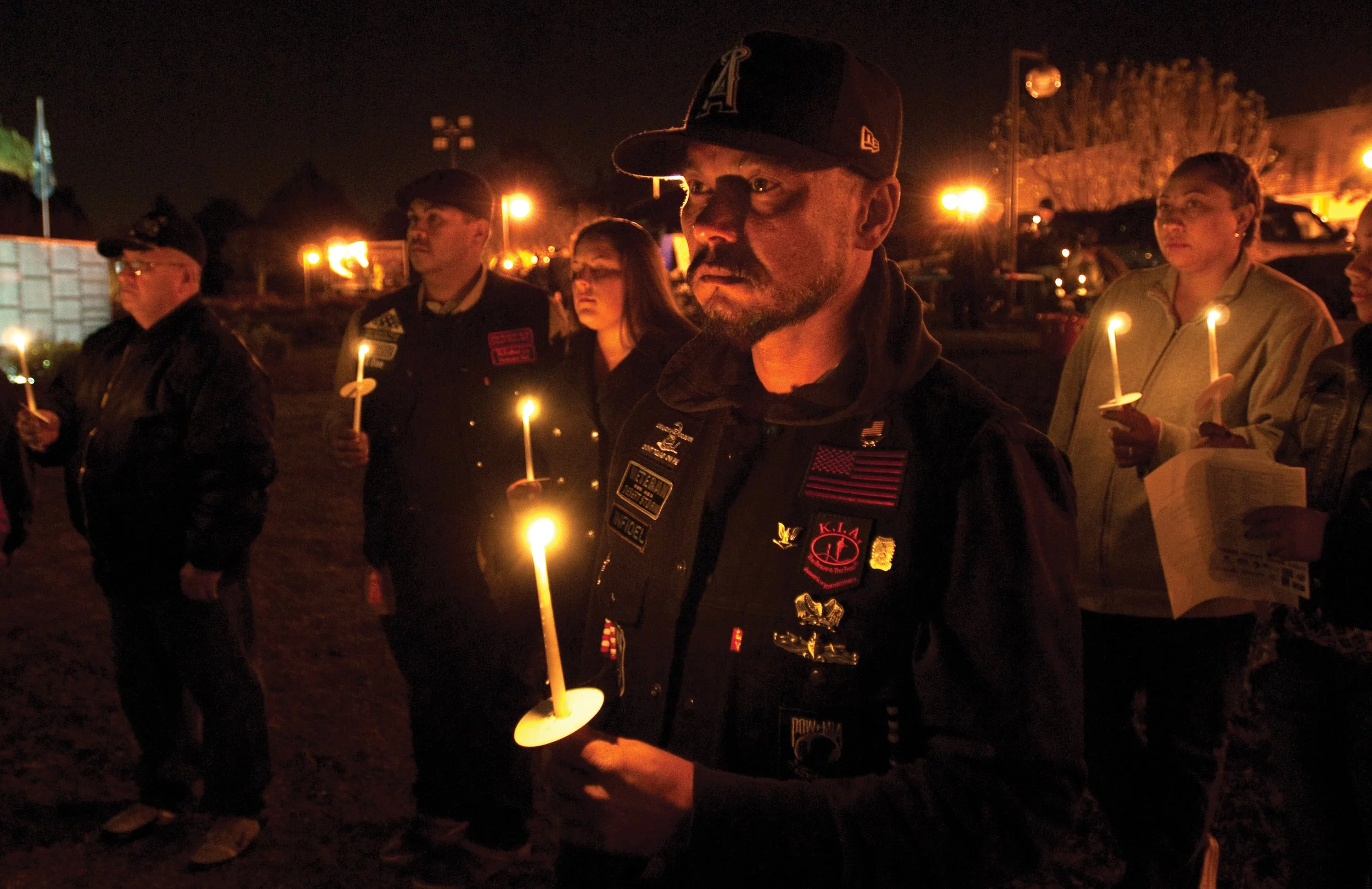
Desert Storm veteran Mike Hernandez of West Covina, CA, participates in a candlelight vigil for POWs and those missing in action. The event was held at the Dignity Memorial Vietnam Wall, a traveling replica of the Vietnam Veterans Memorial, during the wall’s stay at Rose Hills Memorial Park in Whittier, CA. Those who attended also had opportunity to attend free screenings of the film Taking the Hill, which includes Raul Ries’ story of how Jesus’ power liberated him from psychological damage inflicted by war. Photo by Carrie Rosema
It was explained to the veteran that Christ paid the penalty for all sin on the cross and that he simply needed to receive God’s forgiveness by faith. The man prayed to accept Christ, and immediately his face reflected a sense of joy, peace, and relief.
Raul stated, “This film is so important because it opens a doorway to true healing and wholeness that no medication can provide. We cannot erase the past with a delete button—these veterans will always carry their memories. But through the power of God’s Spirit, they can find freedom from guilt, victory over their wounds, and the strength to overcome.”
Raul’s story of struggle and redemption has catalyzed change for veterans nationwide through the Taking the Hill campaign, which brings the documentary to churches, military bases, and other venues. Despite pouring rain, the three screenings at Rose Hills Cemetery in Whittier, CA, were attended by many veterans. The screenings were hosted in conjunction with a traveling Vietnam memorial, a nearly 300-foot replica of the Vietnam Veterans Memorial wall in Washington, D.C. At each showing, people came to know Christ. Raul, senior pastor of Calvary Chapel Golden Springs (CCGC), CA, connected personally with many, both after speaking at one showing and while at the wall. “Every single Taking the Hill event is very intense for me,” he said. “But Christ comforts me. Abiding in Him is completely life-changing.”
Two Battlefields
“Every time I approach the wall, I think about the 58,000 men listed there who gave the ultimate sacrifice for our country’s freedom—and about their families,” Raul remarked. “But then I think about Jesus, who paid the ultimate price to bring us mercy and forgiveness. Without Christ, I would be tortured, miserable, and angry. But He provides cleansing from all sin.” Raul first visited the wall in Washington, D.C., during filming of Taking the Hill, accompanied by fellow veterans Pete Silva, Tom Kamataris, and Pete “Chick” Cicatelli. It was the first time the friends had seen each other since the war. “It was very painful,” Raul confessed. “We had 41 names up there of people we knew. One, ‘Stutes,’ was a close friend.”
The three friends and Stutes were part of Raul’s Marine company, Alpha 1/7. “When we came back to camp after operations, we listened to 1960s music and talked about our families,” he reminisced. “We felt safe in camp, but we knew we’d go out many more times. Every time, someone would get wounded or killed. For 13 months, we worried about that every day.” During one operation, Silva stepped on a foot trap—a hole in the ground containing a grenade—and lost both legs. Raul was with him and actually carried the legs to the medevac. Another day, Stutes triggered a Bouncing Betty, a landmine which detonates above ground. All his limbs were blown off—he bled to death in Chick’s arms.
Witnessing friends’ deaths and injuries profoundly affected Raul. He had always struggled with anger, but he became filled with explosive fury that a brief stay in a psychiatric ward after returning to the U.S. did little to mitigate. Raul soon married Sharon, whom he had known in high school. For years, she and their sons were the targets of Raul’s rage and destructive behavior. He was preparing to kill them all when he struck their TV set with his shotgun, turning it on. Pastor Chuck Smith was on TV, sharing the Gospel. The love Raul saw in Chuck’s face drained his anger, and he knelt there and surrendered his life to God.
For the weapons of our warfare are not carnal but mighty in God for pulling down strongholds. 2 Corinthians 10:4
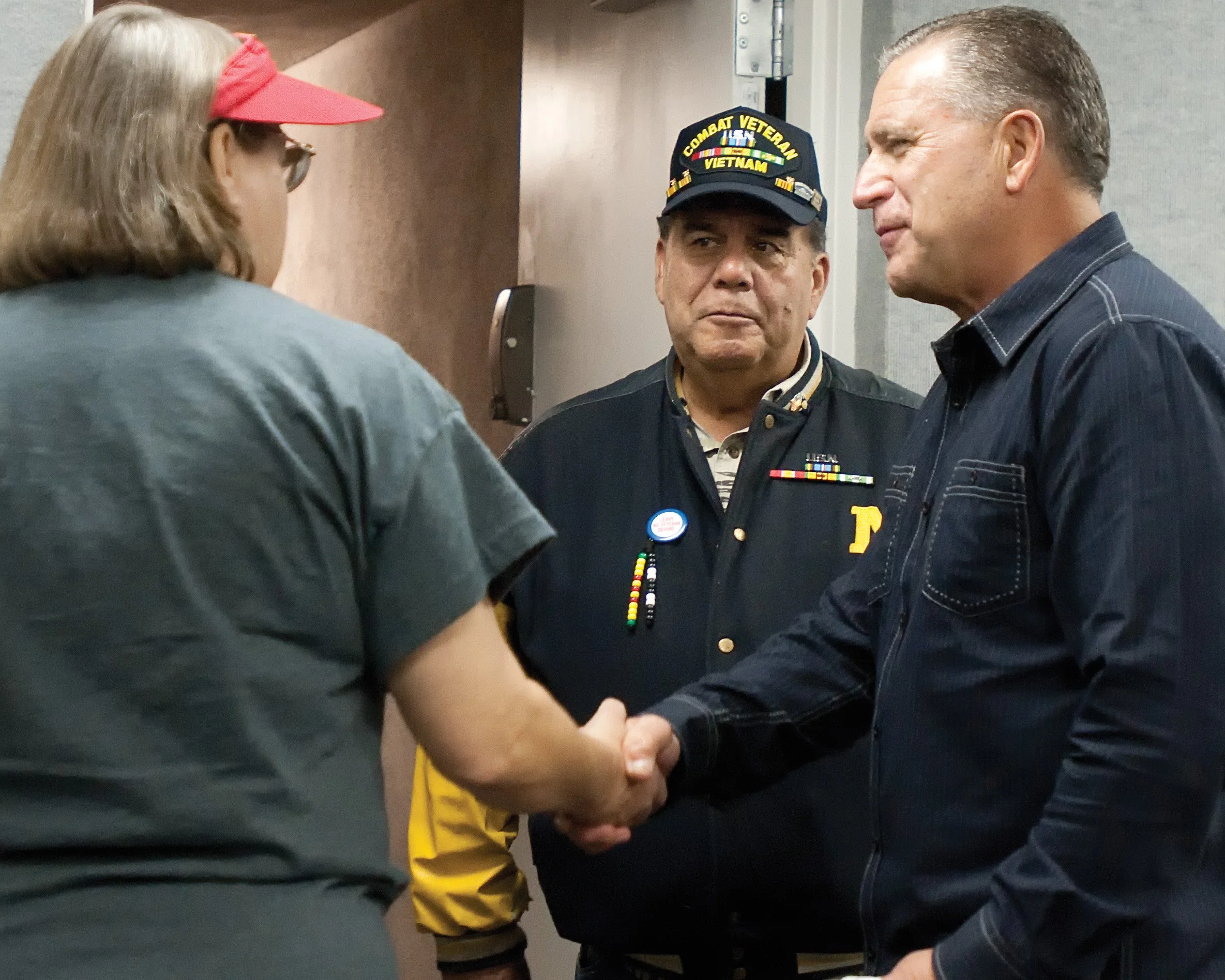
Raul (right) greets a former Marine as Vietnam Navy veteran Ritch Pacheco looks on. Raul tried to connect personally with as many attendees as possible. Photo by Sadie Lyda
Decades later, a woman approached Raul—by that point pastor of Calvary Chapel Golden Springs—at a conference about A Quiet Hope, a 1983 Vietnam documentary that Raul and some of his fellow Calvary Chapel pastors and veterans had participated in. She told him the film had profoundly affected her. “Have you considered making another film?” she asked. He replied, “Probably not,” adding that such a project would cost about $350,000. Laughing, she replied, “Oh, I think it will cost more than that.” She handed him a check for the amount she believed he would need and gave him a warning—“Satan will hate what you do, and will come after you.”
“I told her, ‘He’s always after me,’ but I had no idea what was coming,” Raul confessed. He soon experienced his first flashback. Pulling into his driveway one evening, he stepped out of his car and into Vietnam. Gunfire was all around him; voices shouted in Vietnamese. Raul sprinted down the street, believing the Vietcong were chasing him. Sharon found him lying on the floor of his office, weeping and begging God for help. Though unable to preach or even read for a month, the experience made him more determined to continue.
Freeing Prisoners of War
Encounters at the 22 subsequent public showings of Taking the Hill, in addition to numerous letters and emails, have confirmed the film is exposing and reaching a deep need—not only for Vietnam veterans, but those from all wars and for their families. The film also contains footage from Iraq and Afghanistan, and Rex said they are discovering that the struggles of these different generations of soldiers are remarkably similar. He continued, “Satan wants to keep them prisoners of depression, unforgiveness, and guilt. Through film, we are attacking a spiritual realm. When you go into the enemy’s territory—get ready for a fight. He won’t roll over. He never has. But the Holy Spirit’s power sets captives free.”
Raul still suffers from physical problems which make him unable to speak for brief periods of time. He realizes that not confronting his war memories would be easier—but believes the cost is worth it: “I must reveal everything to minister to these guys. I pick over and over at a scab that’s already healed. But I have to endure that way to bring healing to these guys in Christ. Through it I’ve learned more about His love, grace, mercy, and forgiveness.” Jesus’ Person and power were the focus of his message at Rose Hills, where Raul broke down while mentioning Stutes. The veterans rallied for him, yelling, “God bless you, Raul! We’re with you, Raul!” until he composed himself. When he finished, a biker he had made eye contact with came forward to accept the Savior whom Raul testified had changed him.
For God has not given us a spirit of fear, but of power and of love and of a sound mind. 2 Timothy 1:7
A Personal Mission
Raul aims to give away 10,000 copies of Taking the Hill and translate it into every major language to minister to veterans worldwide. He also desires to hold events on college campuses, raising up a generation that understands and honors veterans. No matter how large the ministry grows, he is determined to stay directly available for emails and conversations. “I want to be personal with these guys,” he said. “It’s hard—most of the time I can hardly talk with them because my heart breaks remembering my experiences, and I cry. But I don’t see that as weakness; I see it as strength from the Lord. My message for them is that Jesus took the hill of Calvary—without that, there’s no redemption. The only way to end the nightmares is to turn completely to Christ, trusting Him. He will heal you, use you, and make you a fruitful person.”
With all boldness, as always, so now also Christ will be magnified in my body, whether by life or by death. For to me, to live is Christ, and to die is gain. Philippians 1:20b-21
WHERE TO FIND THE TRAVELING WALL THIS SUMMER
The powerful themes of forgiveness, legacy, and hope highlighted in Taking the Hill find a physical parallel in The Wall That Heals, a traveling three-quarter scale replica of the Vietnam Veterans Memorial accompanied by a mobile Education Center. Sponsored by the Vietnam Veterans Memorial Fund (VVMF), this exhibition travels to communities across the country to provide a deeply personal space for healing, reflection, and remembrance. It allows veterans, families, and visitors to honor the more than 3 million Americans who served, keeping the legacies of those who made the ultimate sacrifice alive.
Upcoming summer dates and locations for the traveling exhibit “The Wall That Heals,” can be found here.
Thank you for reading! If this story inspired you, we invite you to partner with us in continuing the ministry God started over 27 years ago. We appreciate your prayerful consideration in joining us to reach more souls for Jesus.
SPONSOR MESSAGE: Content here
© 2026 Calvary Chapel Magazine (CCM). All rights reserved. Articles or photographs may not be reproduced without the written permission of CCM. All Scripture quotations, unless otherwise indicated, are taken from the New King James Version. Copyright © 1982 by Thomas Nelson, Inc.® Used by permission.