
Pastors Trip: Exploring the Book of Acts and the Seven Churches of Asia Minor
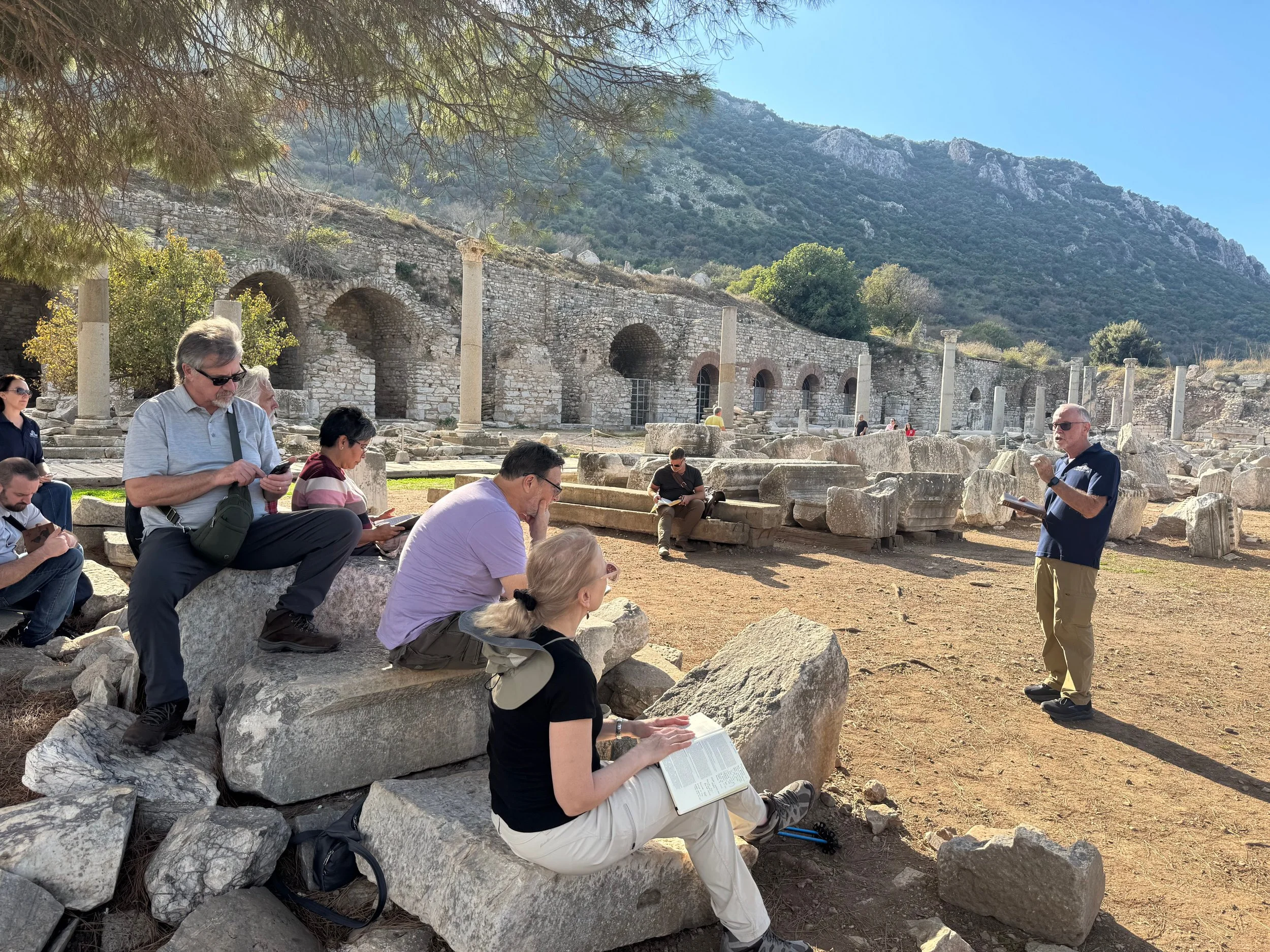
Pastor Ed Seponosky models teaching for the pastors at the Agora in Ephesus, in the area where the apostle Paul might have done his tentmaking and preached publicly in Acts 20:20.
The driver of a tour bus on its way from Antioch Psidia to Iconium, territories in the country of Turkey, unexpectedly slowed down, looking intently for a particular spot. None of the Calvary Chapel pastors and missionaries on board knew what was happening.
“It was an unmarked site, but off to our right, there was a stone bridge that was part of a main first-century road,” exclaimed retired CC Pastor Ed Seponosky, who as the tour’s main teacher had researched many sites in Turkey. “We got off the bus and walked maybe 200 yards on a dirt road to the 2,000-year-old bridge that the apostle Paul would have walked on. I had no idea about this site. It just made his journey real to me. His crossing that bridge was part of his journey that eventually led to Europe, which eventually led to my salvation.”
Associate Pastor Stephen Cange of Riverbend Calvary Chapel, MO, called the bridge a special bonus. “It’s amazing to think that something that would be so significant to us is not even an advertised tourist spot. This ancient bridge is still standing and used. It was pretty cool to be up close and personal with it.”
The small group was on an eight-day pastors familiarization tour, Biblical Turkiye (Turkey) with the Seven Churches (in the Book of the Revelation) in November 2025. Together they followed the footsteps of Paul and other apostles, exploring ancient Ephesus, Pergamon, Thyatira, Smyrna, Sardis, Philadelphia, and Laodicea, as well as other locations rarely mentioned in the Scriptures. They learned that even a small mention in the Bible often meant great ministry.
Great Distances for the Gospel
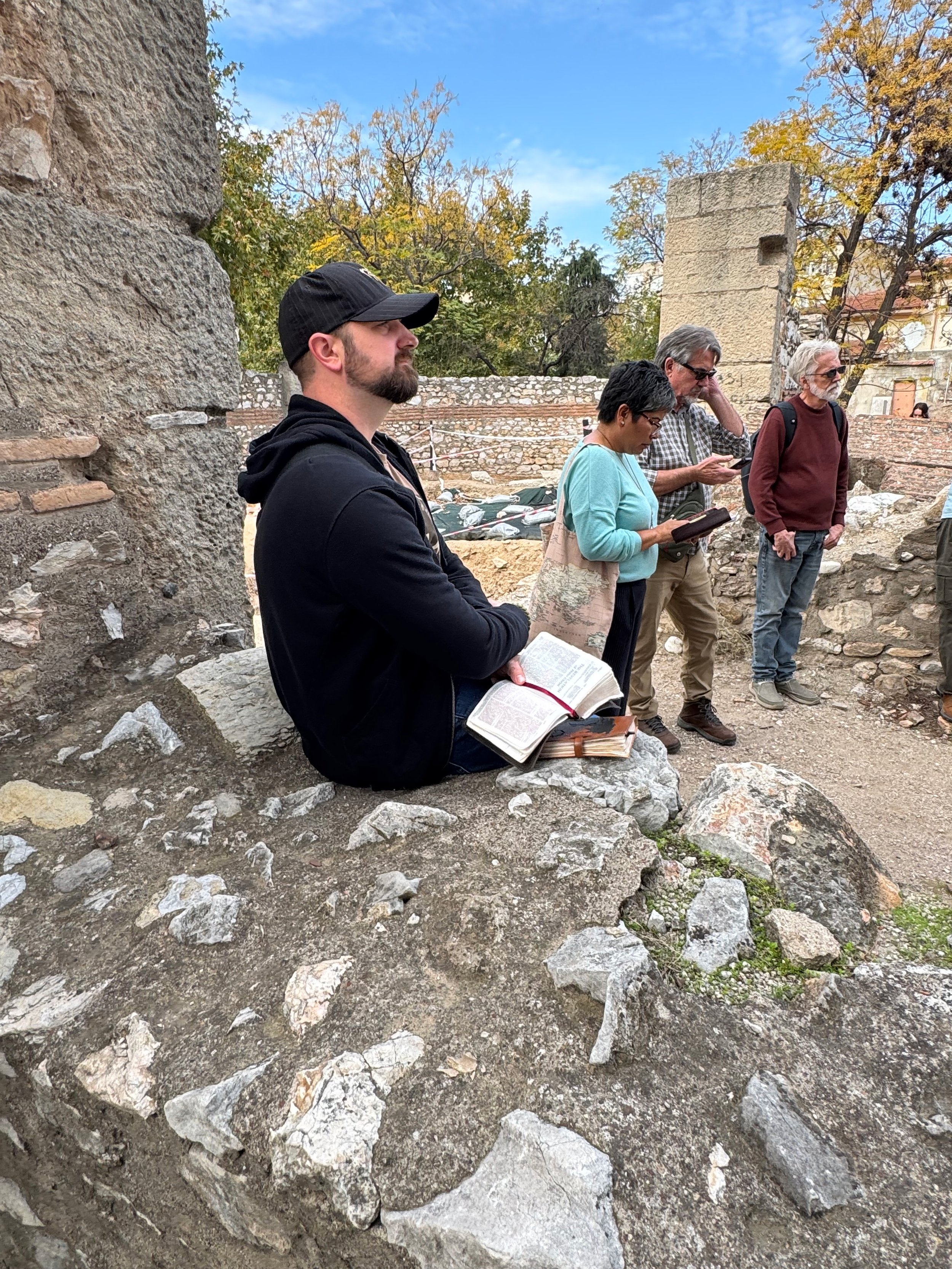
Left: Associate Pastor Stephen Cange of Riverbend Calvary Chapel in Washington, MO, sits on the ruins of the basilica in ancient Thyatira, intently listening to the teaching at the site.
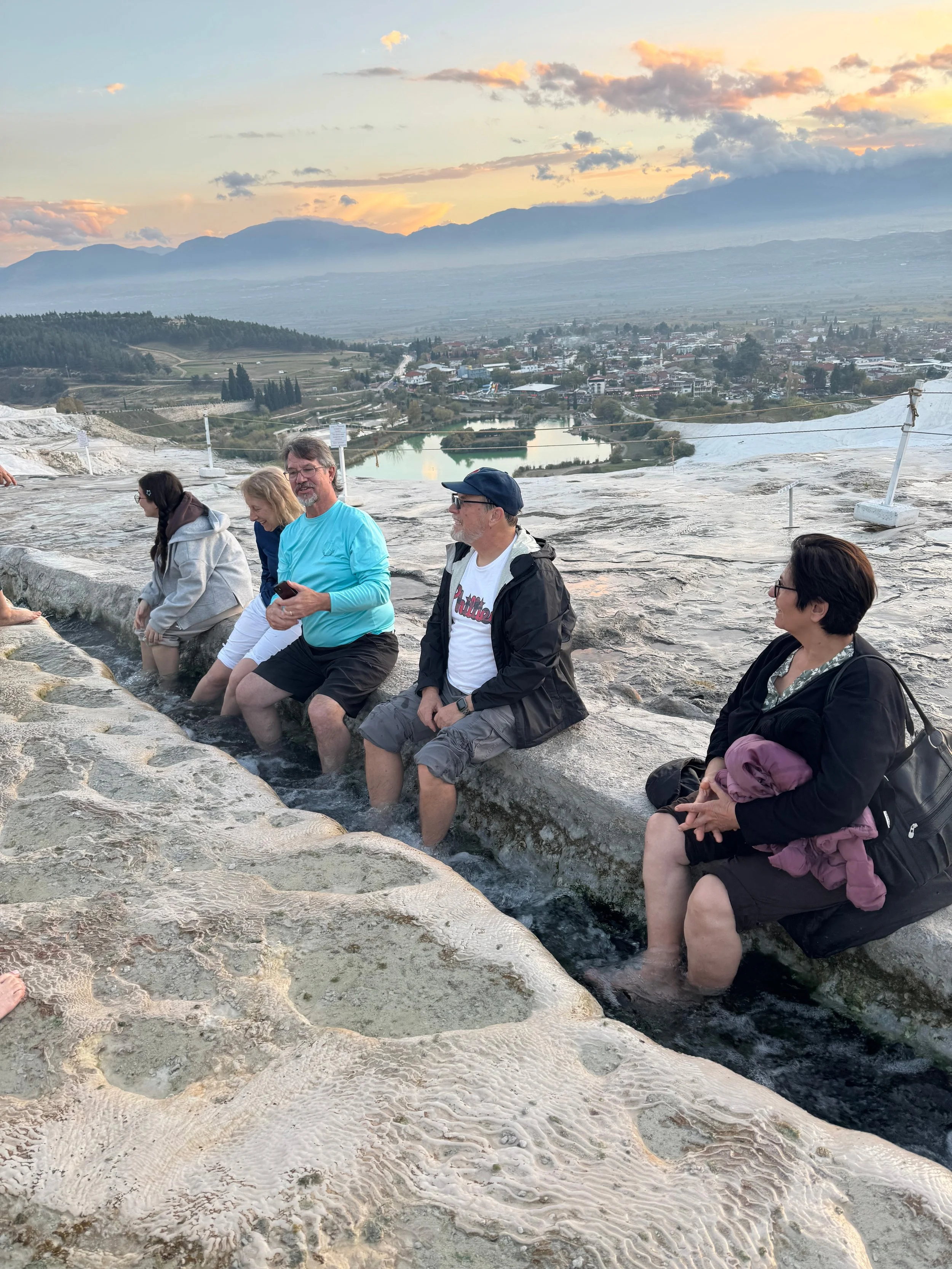
Right: Pastor William Menner (center) of Calvary Chapel Midcoast Maine and others from the group enjoy the flowing water of the hot springs in Hierapolis (modern-day Pamukkale), where the hot water began its journey to nearby Laodicea, arriving lukewarm.
Although few chapters, or even mere verses, often separate the narratives of the Book of Acts, or the seven churches Jesus addressed in the Book of the Revelation, the tour group was surprised by the great distances between the important biblical sites. Pastor Ed explained, “But we know things happened between these sites as well. In between his more well-known stops, Paul didn’t just pass by without saying something—the Gospel went to many of these places. Isn’t that how many of us feel, that our lives aren’t recorded or important? Yet when we’re faithful, it’s not about being recorded. The people between the cities were faithful, too.”
Francis Green, who serves in a grief share ministry at a Calvary Chapel, affirmed that those distances gave him greater appreciation for and a different perspective on Paul’s journeys. “We were in a bus, and we got from one place to another in a half-hour to two hours. And then we stayed in hotels. But Paul did it by foot, walking the mountains. Our roads to the mountains and the passes were pretty much the same. I picture Paul walking and meeting the people.”
Pastor William and Diane Menner of Calvary Chapel Midcoast Maine noted that the terrain, even with modern-day conditions, was not easy. “This journey for Paul and his fellow missionaries was so much of a calling and so heavy on their hearts. There really was no way they managed to do what they did without the power of Jesus in them,” Diane marveled.
Tour guide Isa Lavant Gurcazdi told the group about a weekend trip—replicating just eight miles of Paul’s known journey, an area high in elevation—with his own tour guides. Diane recalled, “They had hiking shoes, warm clothing, water, prepared food, and even campsites set up with heaters—all the comforts you would need. He said that so many people had to drop out and couldn’t go on; by the end of the trip, Issa himself reported being unable to breathe at the high elevation at certain points, despite all their modern assistance.”
Pastor William noted, “What strikes me is that Christianity was born out of something that these folks were empowered by the Holy Spirit to do, but they were rugged, fearless people. The churches faced tremendous persecution; yet they were able to persevere.” He laughed, adding, “You leave there and think, What a wimp I am. We’re lazy, spoiled. Western Christianity doesn’t understand sacrifice and persecution, a lot of things that they endured.”
Where the Church Began to Move
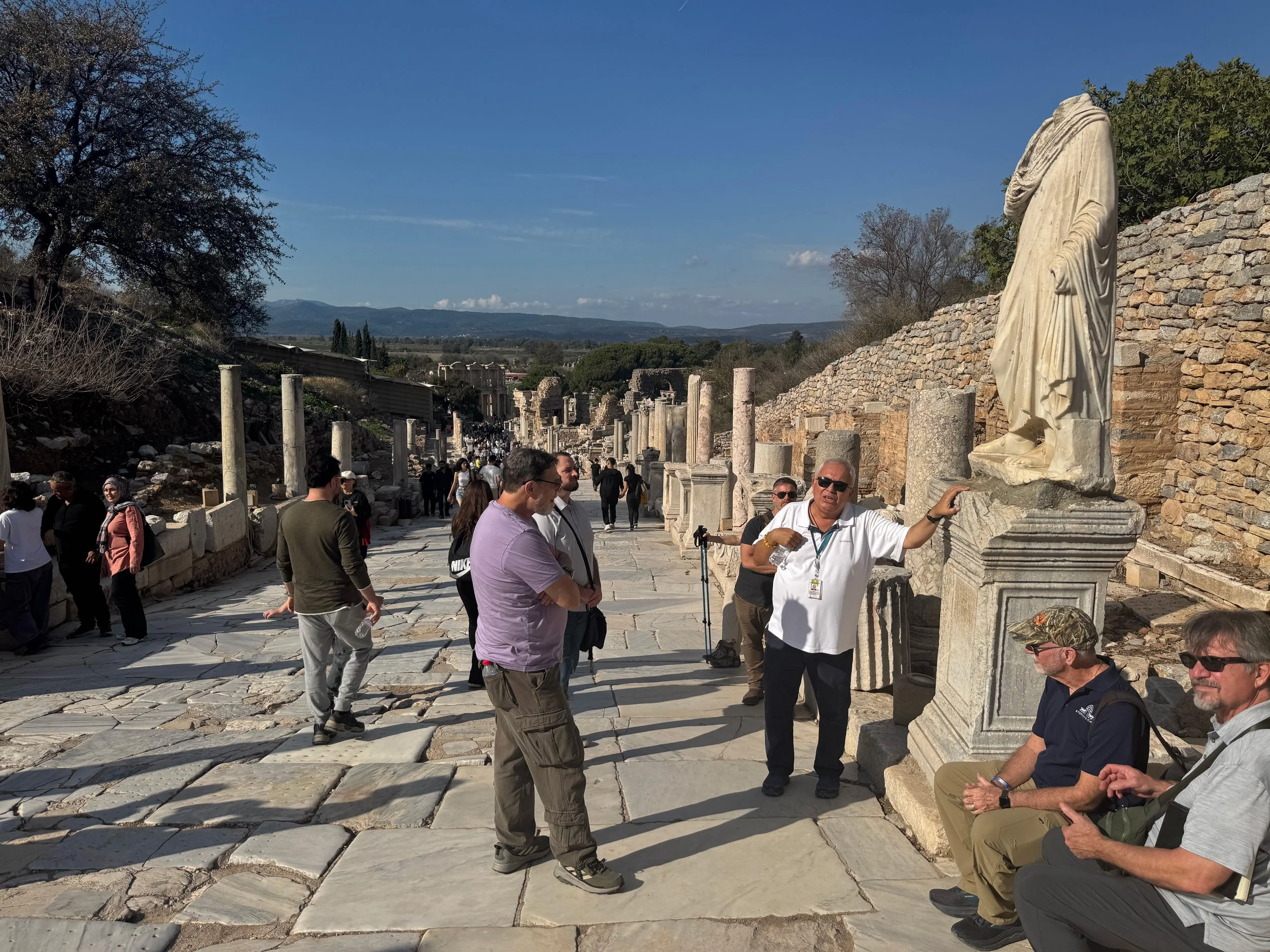
Christian Guide Isa Levant Gurcavdi points out a headless Roman statue on Curetes Street, the main luxury road connecting the ancient city of Ephesus to the harbor.
Why travel to Turkey? Pastor Ed responded, “Turkey is a central part of the early Church—the place where the Church began to move.”
The early Church was born in Jerusalem on the Day of Pentecost when the Holy Spirit came down in tongues of flames, allowing the apostles to preach to the gathered Jews, including those from parts of Turkey (then known as Asia Minor), in their own languages—languages the apostles did not know, Pastor Ed revealed. “They heard the Gospel in their own languages” and took it back to their homes.
And there were dwelling in Jerusalem Jews, devout men, from every nation under heaven. And when this sound occurred, the multitude came together, and were confused, because everyone heard them speak in his own language. Then they were all amazed and marveled, saying to one another, “Look, are not all these who speak Galileans? And how is it that we hear, each in our own language in which we were born? Parthians and Medes …, Judea and Cappadocia, Pontus and Asia, Phrygia and Pamphylia, … both Jews and proselytes, …—we hear them speaking in our own tongues the wonderful works of God.” Acts 2:5-11
Ed expounded, “When Jesus gave the instruction to go to the uttermost parts of the world, they began to move from what we call modern-day Lebanon or Syria. The geographic area of Syria today is not the Syria of the time of Jesus; it was a larger region. Paul’s home base, Antioch of Syria, was actually in modern-day Turkey, just north of Syria today.”
Scripture in Living Color
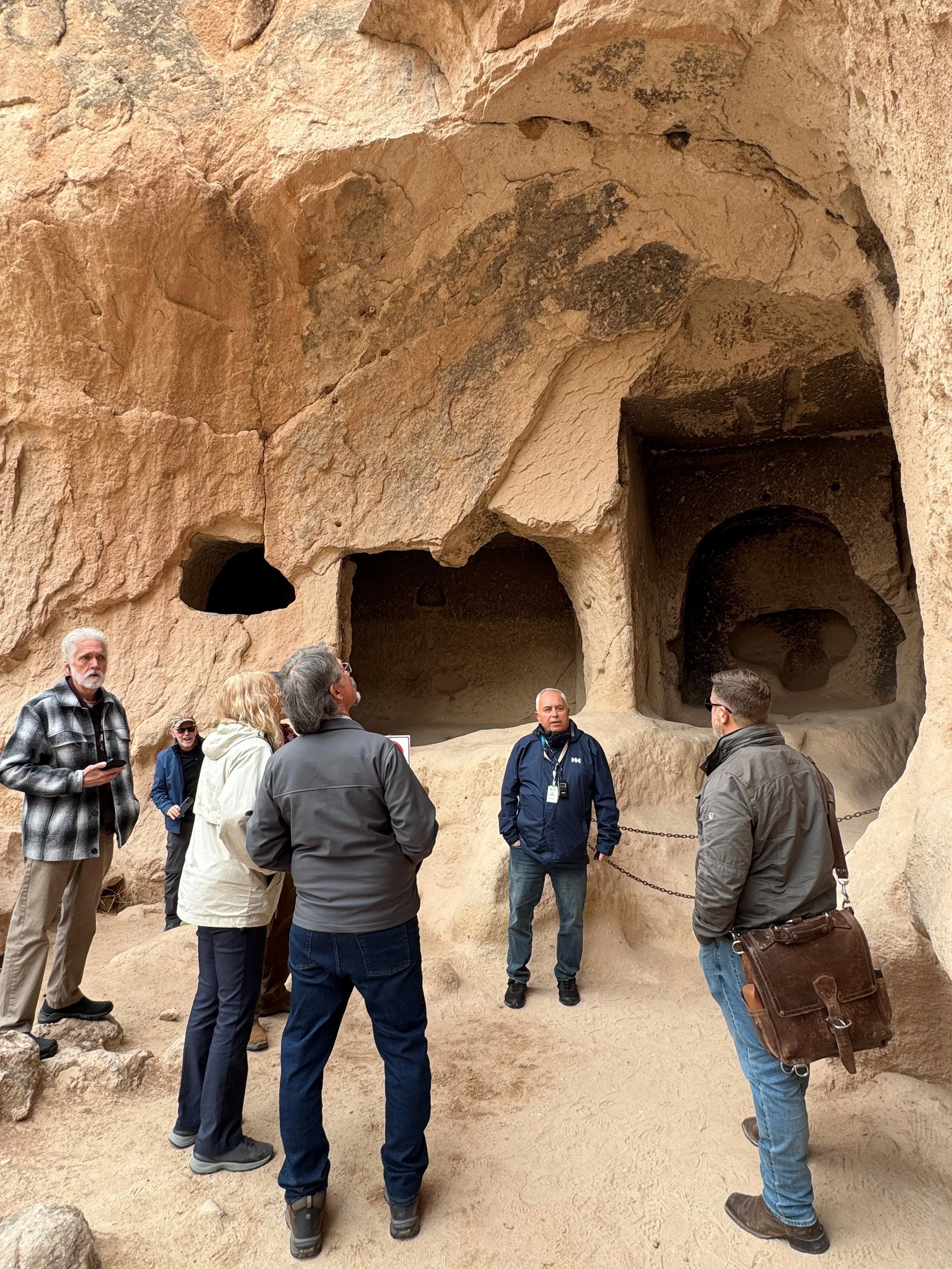
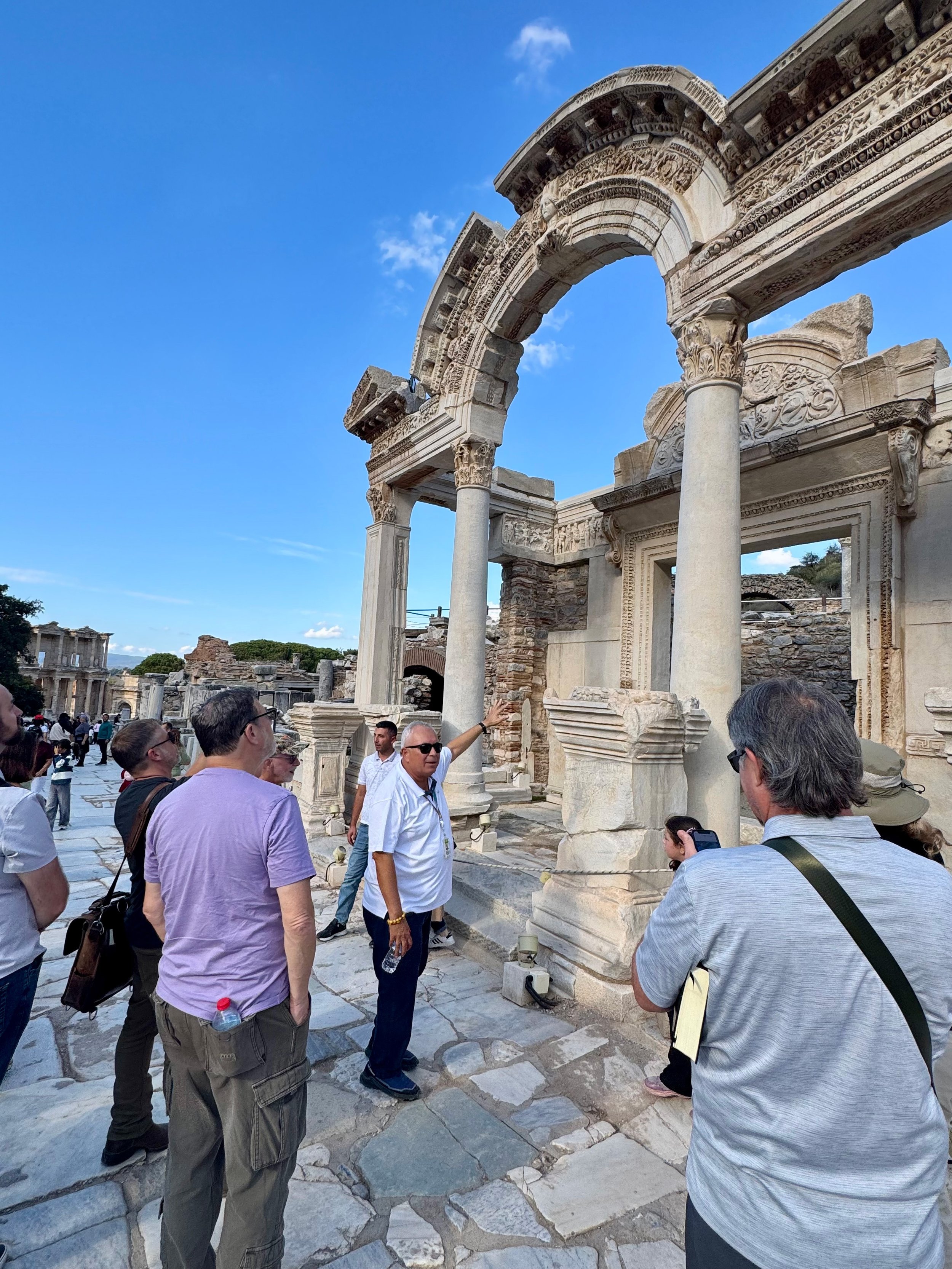
LEFT: The group from the Pastors’ Familiarization Tour of Biblical Turkey enter an area in Cappadocia (near Galatia) that is known for its unique and intriguing landscape containing houses and churches carved out of the volcanic ash.
RIGHT: Guide Isa shows a Christian reference at the Arch of Titus along the main road in ancient Ephesus.
The history, geography, and features of each site they toured invoked spiritual application and brought to life the narratives of Scripture and Church history. William affirmed, “It’s all archeologically and historically factual—more facts to back up the written Word of God.”
Individuals on the tour shared a few of many revelations.
Smyrna, current-day Izmir, was the home of Polycarp, a disciple of the apostle John who was martyred for his stand for Christ. “I had a sweet encounter with the Lord there, a persecuted church, a persecuted people,” stated Steve Thomas, senior pastor of Riverbend Calvary Chapel. “I’ve read so many stories about Polycarp, the first bishop of Smyrna. Looking over the hill, he’s got a grave somewhere. Putting myself into the story, I just feel the love of Jesus and the power of the cross, realizing that it’s not about me or what I can bring to the table. It’s about me being obedient to Jesus, trusting in His power and the filling of the Holy Spirit. That’s how these people were able to stand. They were strengthened in the Lord.” Steve further mused, “There’s nothing new under the sun. People all over the world are dealing with persecution but are staying victorious. Our God is alive.”
Diane added, “Polycarp was sure of the Lord, and a few years later, persecutors gathered 1,500 Christians and tried to get them to deny their faith. We were at the open field there, where they were killed. Years after that, another 800 Christians were killed,” Diane recollected. “I just stood there as a Christian, realizing they all died knowing that they wouldn’t deny Him. It’s a surreal experience to be in a place where so many Christians were martyred for their faith.”
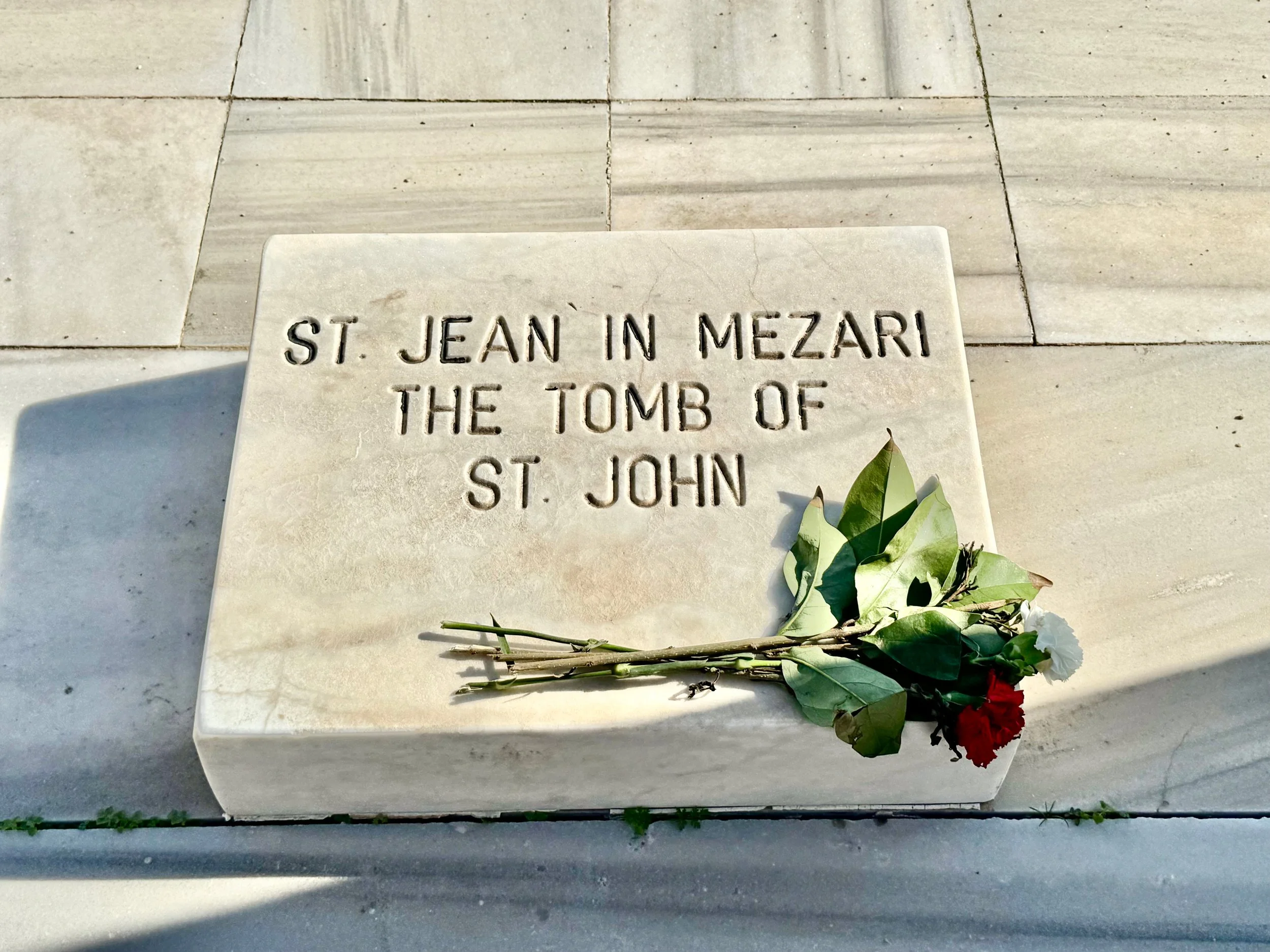
On a hill across from the main archeological site is a hill that may have been the original site of Ephesus, where this marker at the Basilica of St. John marks the possible location where the apostle John was buried.
Ancient Philadelphia, now just a street block located in Alasehir, is considered the “faithful church.” Very little in Philadelphia is developed, Pastor Ed stated. “It’s believed that the early basilicas in Philadelphia had four major columns. And parts of three of them are [still standing]. It’s the only thing you can really see. To see these pillars, it just really starts to come alive.”
“He who overcomes, I [Jesus] will make him a pillar in the temple of My God, and he shall go out no more.” Revelation 3:12a
Just across the street from the pillars, Diane recalled that there is a large mosque. “When we were there, we heard the Islamic call to prayer on the loudspeaker. To have a mosque across the street from the faithful church of Philadelphia—it hurt my heart. I can only imagine how it hurt God’s heart.”
Ancient Thyatira in Akhisar was known as the “corrupted church.” Stephen reflected: “They had really compromised by getting involved with the literal gods of industry in that area. Most of that site is now covered with industry. There’s very little that they’ve recovered, and it would be very difficult for them to recover more because they’d have to tear down businesses and homes.”
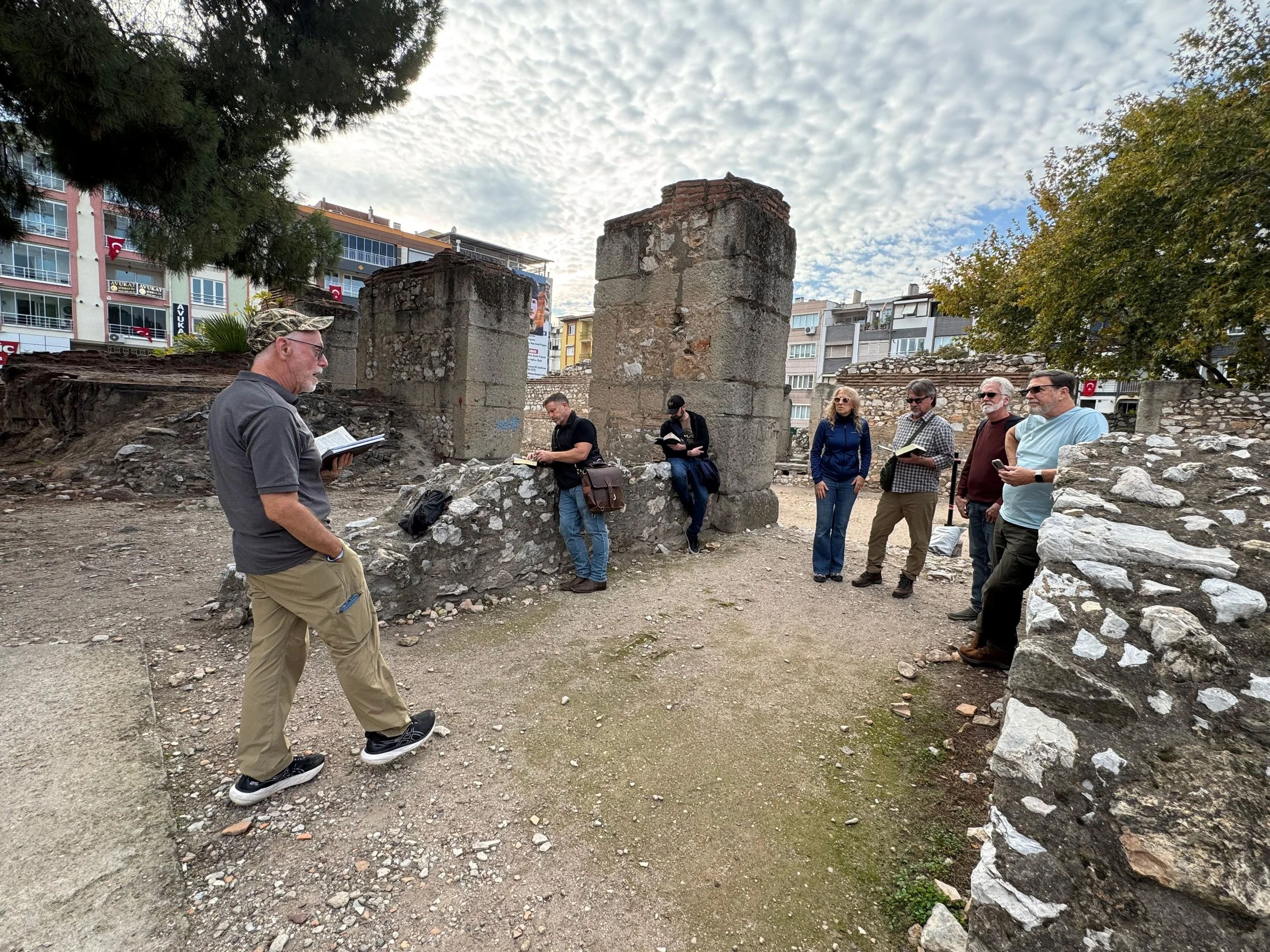
At the ruins of a basilica in ancient Thyatira (modern-day Akhisar), Pastor Ed teaches from Revelation 2:18-19 about the “corrupt church” that received praise for its works, love, service, faith, and patience—but also allowed for the worship of idols.
Pergamon, called the “compromising church,” was a fortress on the top of a hill—to get there requires a tram ride up, Stephen said. “It really spoke to me that a lot of times you feel fortified and safe in compromise, but you don’t realize the danger that you’re in with the Lord.”
Pergamon was also home to a high place, where there had been an altar to the Greek god Zeus, Pastor William revealed. “In Revelation 2:13, it’s called where Satan dwells. When the church was established, many were offering sacrifices on this altar and also on altars dedicated to Caesar as part of the culture. The church at Pergamon unfortunately fell into this practice and became known as the “compromising church.”
In Antioch of Psidia, in an ancient church ruin, “we read in Acts 13 the words Paul preached in this same location 2,000 years ago (Acts 13:13-52). A Muslim couple joined us for that little Bible study. They stayed for the whole thing and were very friendly afterwards,” Stephen joyfully remembered.
Cappadocia: Faithfulness in the Caves
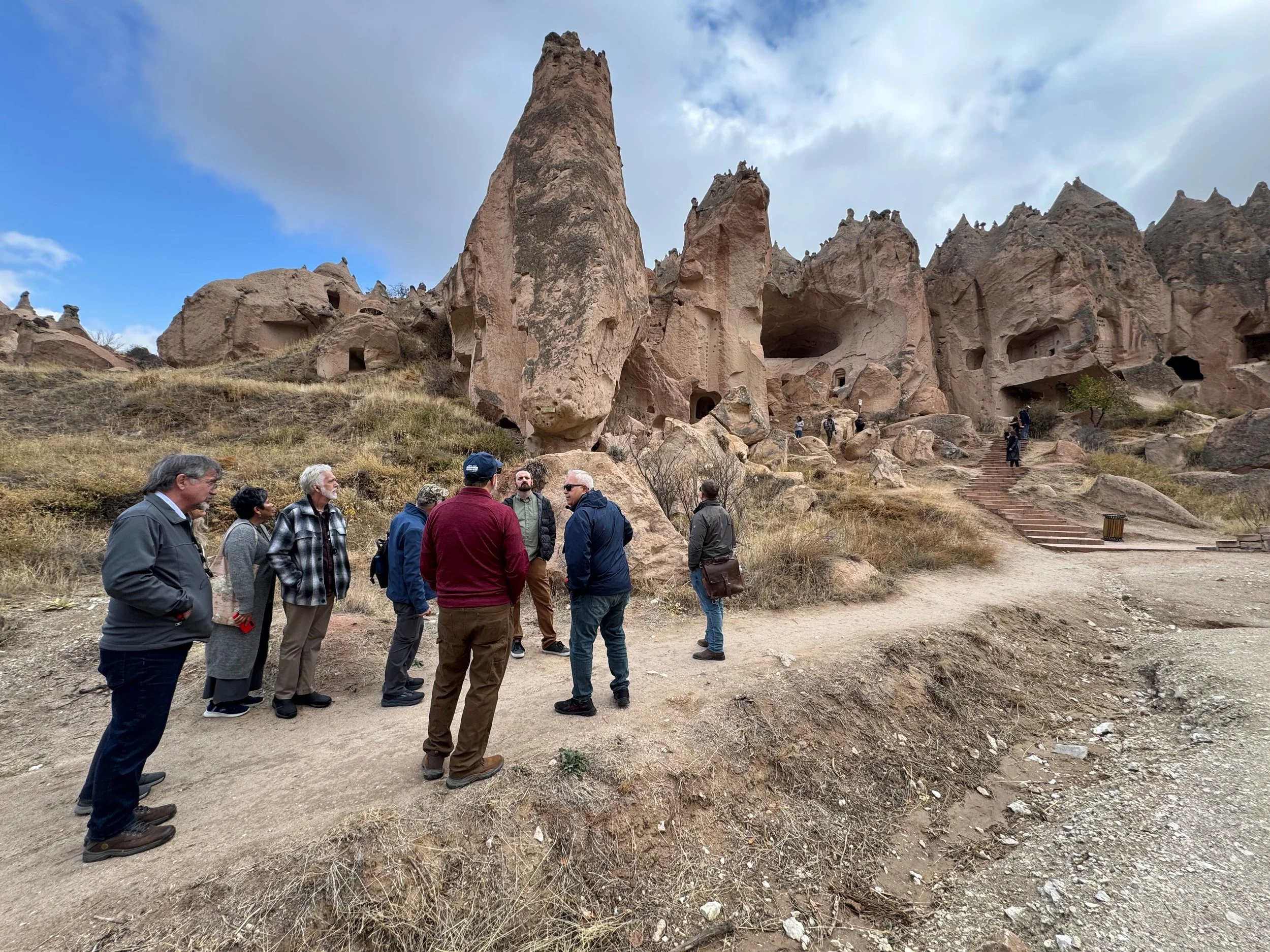
Guide Isa describes the many Cappadocian churches in the caves and passageways between the caves as the group is about to enter and explore these underground cities used by the early Christian Church to survive heavy persecution. It was in this area that early Church father Gregory of Nyssa agreed in the early AD 380s that “one might more justly consider that He (the Holy Spirit) dwelt in the Cappadocian nation more than anywhere else.”
Peter, an apostle of Jesus Christ, to the pilgrims of the Dispersion in Pontus, Galatia, Cappadocia, Asia, and Bithynia, elect according to the foreknowledge of God the Father, in sanctification of the Spirit, for obedience and sprinkling of the blood of Jesus Christ: Grace to you and peace be multiplied. 1 Peter 1:1-2
“There’s something powerful about this area, something surprising and pleasant for me,” Pastor Steve Thomas declared of Cappadocia, a region noted for its “otherworldly landscapes” dotted with many intricate basalt caves that served as homes and churches for early Christians. Although Paul would have visited there, there is only a brief mention in 1st Peter and no description in the New Testament. “But there’s such rich spiritual value and opportunity to dive into 1st and 2nd Peter. I don’t think I’ll read those chapters the same again. There’s a message to all of us to hold fast and find our strength in Christ.”
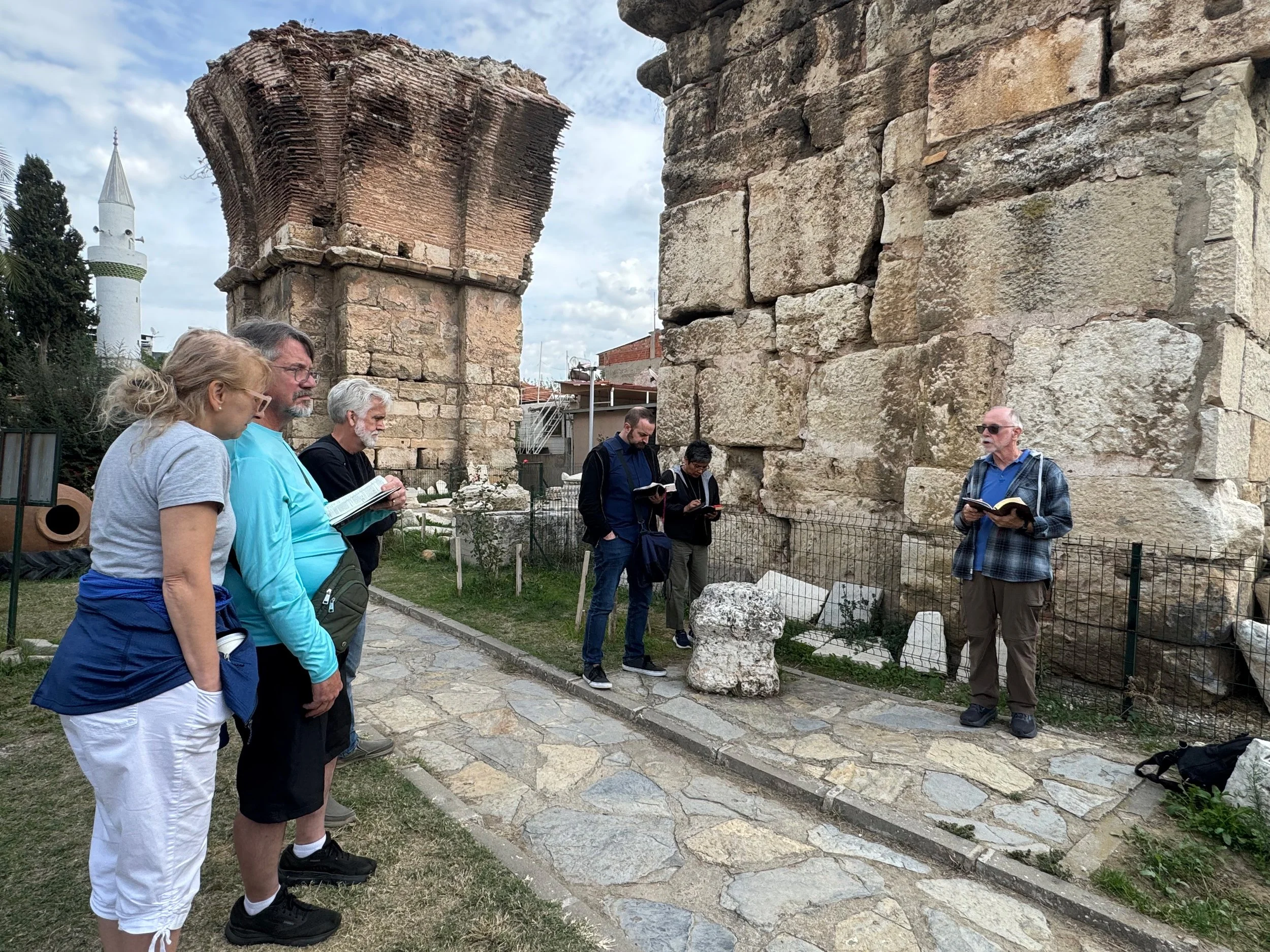
Ed shares at the remains in Philadelphia (modern-day Alasehir), where three of the four massive pillars still stand today. It was to the faithful church at Philadelphia that Jesus promised, in Revelation 3:7-13, they would become a pillar in the temple of His God.
Ed elaborated on its rich Church history: “The apostle Peter was writing to believers in Cappadocia, who had been dispersed because of persecution for at least the first 300 years AD. Why were there so many churches in these caves? It’s because they always wanted a place where they could gather, even if it was only with their families, to worship. Some of these caves were connected by tunnels to each other, so they could have the fellowship of other believers there. How faithful they were!”
Inside the caves, visitors can still see the remnants of how the churches were set up. Diane described what she saw: “One of the cave entrances was to a place of worship, and inside they would have a scroll laid out on a long table. You’d see etchings on the walls of everything from the Lord’s supper to Jesus and Mary—just beautiful art. In those caves, each one of those chimney rocks, was its own village; and each had its own church. That’s how prevalent the church was.”
Ed explained that Cappadocia was instrumental in producing the early Church fathers. One of them, he said, “reported that the Holy Spirit was so powerful there, that he couldn’t imagine it being more powerful anywhere else. Peter wrote them about how the Spirit of God allowed them to persevere. He kept them, and He’s keeping us today.”
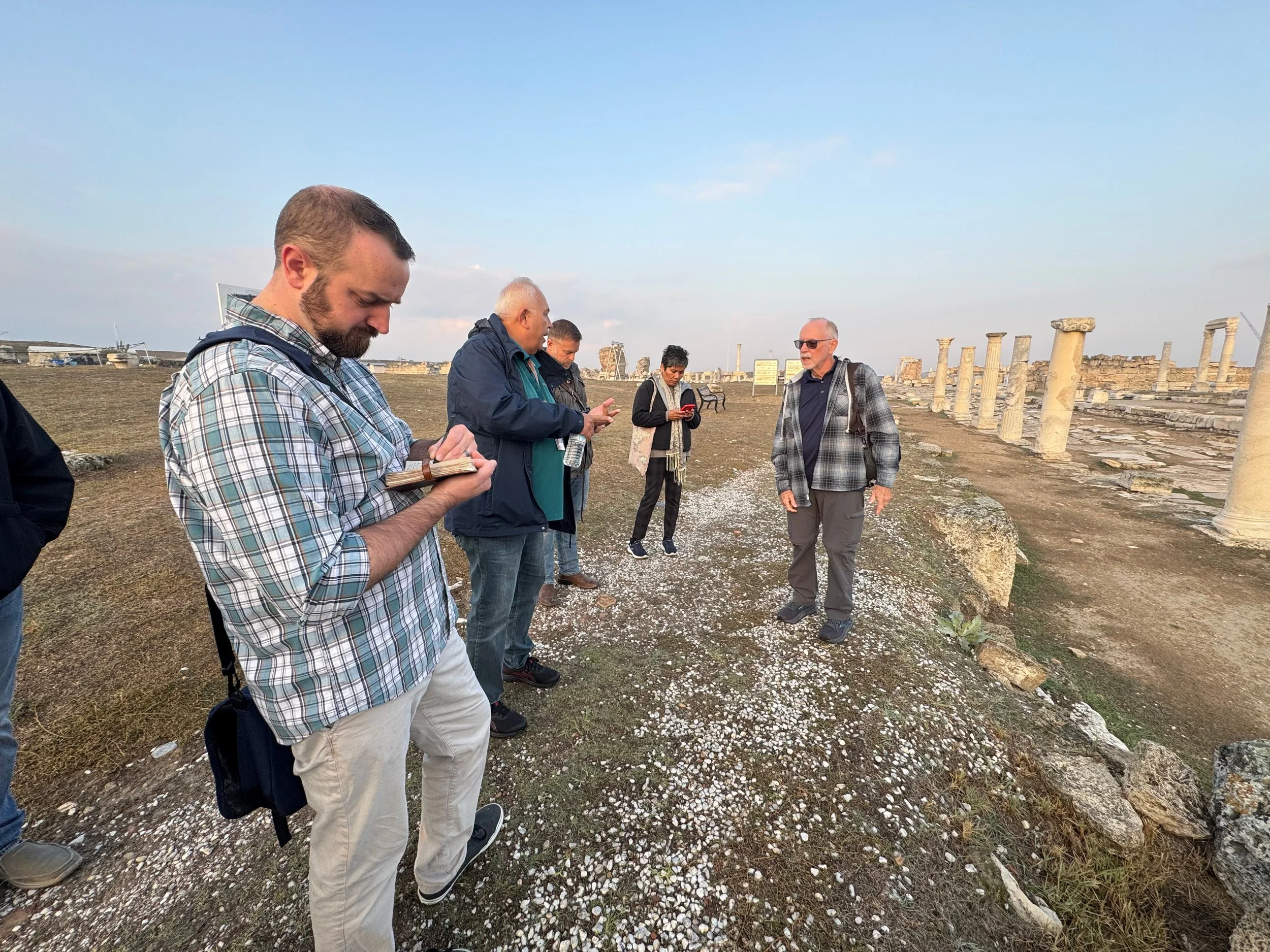
Pastors Steve Thomas, Stephen Cange, and Ed Sephonsky listen to guide Issa as he shares with the group as they are on the cardo (main street) of the ruins in Laodicea.
Thank you for reading! If this story inspired you, we invite you to partner with us in continuing the ministry God started over 27 years ago. We appreciate your prayerful consideration in joining us to reach more souls for Jesus.

SPONSOR MESSAGE: Learn about a full-service travel agency hosting custom Bible land tours designed for those with a passion for God’s Word and His people.
Stephen’s Gate Tours by Mayfair Travel
© 2026 Calvary Chapel Magazine (CCM). All rights reserved. Articles or photographs may not be reproduced without the written permission of CCM. All Scripture quotations, unless otherwise indicated, are taken from the New King James Version. Copyright © 1982 by Thomas Nelson, Inc.® Used by permission.