Talking with Young People About Gender Issues

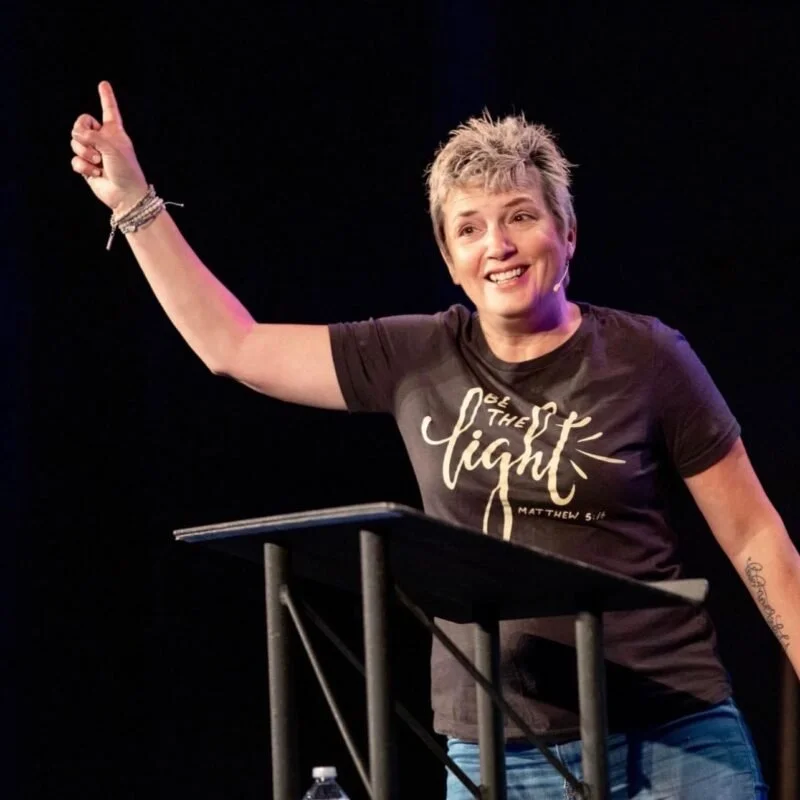
Out of Egypt, the speaking ministry of Patti Height, is the platform she uses to equip Christians via the local church and other venues to reach out and minister to the LGBT community; as well as those within the church who struggle with unwanted same-sex attraction or gender confusion, with the love and truth of the Gospel. Photos courtesy of Out of Eygpt Ministries.
This article first appeared in Calvary Chapel Magazine Issue 78, Winter 2019.
Suffering with severe gender dysphoria (distress) from a young age, Patti Height had lived many years in the homosexual lifestyle when God opened her eyes through His Word to understand that homosexuality is a sin (see Leviticus 18:22). She then began to seek Him and surrendered her heart to Christ at CC Old Bridge, NJ, in 2003. Later, she founded Out of Egypt Ministries to educate believers on reaching out to those in gender confusion. Patti discusses how to share God’s truth in love with young people in a world saturated with lies.
Q: Is gender my choice or God’s intention?
A: We are hearing a lot today about gender being fluid, and this can be confusing. We need to look to God’s Word, which is true whether we agree with it or not. God created each of us for His glory, not our own. Isaiah 43:7 says, “Everyone who is called by My name, whom I have created for My glory; I have formed him, yes, I have made him.” God made our bodies with a good intention because He is good. From the beginning of creation, “God created them male and female” (Genesis 5:2, Mark 10:6)—period. No matter how hard we try, we cannot successfully undo what God has done. In fact, a secular, 30-year study in Sweden found that those who had sex-change operations had “considerably higher risks for mortality, suicidal behavior, and psychiatric morbidity than the general population” (PLoS ONE). God knew us before He formed us in our mother’s womb (Jeremiah 1:5), and there are 6,500 genetic differences between men and women. Our sex is definitely, intentionally given to us by God.
Q: What is transgender, gender confusion, and gender dysphoria?
A: The world defines transgender as when someone’s biological sex is incongruent with their own mental concept of their gender. Gender confusion is when one is not comfortable or at ease with their biological gender. Psychiatrists define gender dysphoria as when a person experiences distress because of their assigned gender. My own gender confusion led to severe gender dysphoria and self-destruction. I was 8 years old when my mother took me to the doctor because I thought I was a boy. He told her not to worry about it, and that I’d make a fine wife one day. And he wasn’t far off. Statistics show that 80-90% of children who have gender confusion grow out of it once they pass through puberty. But that was before the genderfluid attitude of our culture today. Now parents are allowing kids to identify as transgender in kindergarten, and to take puberty blockers before they hit puberty. Not only can puberty blockers make children sterile, but they can also keep kids from growing out of gender confusion after puberty. My gender confusion grew to severe gender dysphoria: I hated my body, so I started to self-injure at 5 and 6 years old. At 12 I started drinking; at 13 I started doing drugs. I felt genderless. It was only after repenting and receiving Jesus Christ that I was able to understand that my gender dysphoria came from witnessing men abusing women both emotionally and sexually. Now, I know who I am in Jesus Christ. Even on days when I don’t feel it, I believe it because His Word says I’m His. Sadly, the acceptance and push that we have in society now has a huge impact on young people who have gender confusion, to spur them to identify as transgender. There’s an incredible pressure: it’s damaging so many young people.
Q: Should Christian parents or leaders talk to teens about gender confusion?
A: Absolutely. I believe that, instead of talking to adults about these questions, most young people talk to each other or go to the internet—and that’s where they are being deceived. What they don’t realize is that they might be listening to somebody who has severe gender dysphoria (distress over their biological gender)—and may also have severe depression or a mental disorder. It’s always dangerous to get our truth from the internet instead of God’s Word or trusted church leaders. The entrance of Your words gives light; it gives understanding to the simple (Psalm 119:130). Any other source can lead to young people being lost or deceived. My hope is that we can bridge that gap and be safe people to whom young people want to talk. So they don’t think that adults are “haters,” “homophobes,” or “transphobes.” We need to be the ones that the younger generation can turn to for truth—just as God used believers to reach the young hippies in the Jesus Movement; we need to bridge the gap for this generation.
“My hope is that we can bridge that gap and be safe people to whom young people want to talk.”
Q: What approach should we take with young people on this topic?
A: First, be a good listener; don’t always be quick to have an answer. Be sympathetic about what they are goingthrough. Don’t dismiss their feelings or tell them their feelings are wrong. Feelings are real, though they are not the same as truth. Jesus Christ is the Truth; God’s Word is the truth. But feelings are very real to young people. When someone is opening up to you, listen—it will help you connect with them and pray effectively for them. So if someone says, “I’ve felt this way my whole life,” you can’t say, “No, that’s not true.” But you can say, “Wow, you must be a very strong person to have dealt with this since you were little. I’m going to be praying for you as you enter these new stages of life—high school, college, these spiritual battlegrounds.”
And a servant of the Lord must not quarrel but be gentle to all … in humility correcting those who are in opposition, if God perhaps will grant them repentance, so that they may know the truth. 2 Timothy 2:24-25
Second, when someone opens themselves up to us, it is a huge opportunity to go home and get on our knees for that person. I like to pray Scripture for people; I call it praying truth back to Truth, because God’s Word is truth and Jesus is the Truth. Then we know we are praying in His will. I’ll ask Him to show me which verses to pray for that person. I’ll also ask Him to reveal the root causes: What was going on in this young person’s life to cause this confusion? I’ll ask God either to reveal that to me (the gift of knowledge) or to that young person, so that as their heart begins to open up with those old wounds, the Holy Spirit can minister to them, and show them that they were created intentionally as a male or female by God, and that His intention toward them is good.
Q: What are some misconceptions about gender?
A: We don’t have to listen to the labels of the world. A man may naturally have characteristics that our society classifies as “effeminate”—but that doesn’t mean that he is transgender or homosexual. That is just his personality, and that’s okay. When you and I surrender ourselves to the Lord, He starts building us up in all the ways He created us, including our gender. It wasn’t until I had been saved for three years that the Lord really started talking to me about my gender issues. I remember Him clearly pressing on my heart to pray, “Lord, show me what it is to be a woman.” I didn’t want to pray that. Even though I was head over heels in love with the Lord. I depended on Him, I trusted Him. I knew He wouldn’t lead me in any direction that was going to wreak havoc on my life, that he was going to heal me not hurt me. Yet I was so scared to pray that prayer. But I knew obedience was so important, so key to my walk with Him. So I asked some Christian sisters to pray that for me and with me, and God has been answering that prayer. We can pray for those things, asking God to help us be the people He created us to be. Psalm 139:1-3 says, O Lord, You have searched me and known me. …You understand my thought afar off … and are acquainted with all my ways. He knows who we are and what we need.
Q: My friend wants me to call them he or she even though that’s not their biological gender. What should I do?
A: Even though we want to show love and connect with young people, if we feed into the deception they are walking in, then we are hurting them, not helping them. Personally, I don’t feel we should use different pronouns for transgender kids. I get a lot of heat for that. But I know that, for me, being called ‘he’ as a 14-year-old girl would have made my gender dysphoria worse. We must pray and ask the Lord how to minister to each young person He brings into our lives. God created that young person: “Before I formed you in the womb I knew you; before you were born I sanctified you” (Jeremiah 1:5a). So we can say, “I love and care about you, and I care about what you’re going through. I believe God created you as a male, so I’m not going to call you ‘she’ because I feel like I would be lying to you. So let’s pray and ask the Lord how we can come together on this and still be a part of each other’s lives. Are you willing to do that?”
Another example: If a teenage boy wants to dress like a girl and go to girls’ Bible studies, that’s not what he needs. If he isn’t comfortable in the boys-only study, perhaps because he might be made fun of, then a youth worker can spend one-on-one time with him. Encourage him in his manhood. And it is going to take a long time, so you have to be willing to give of yourself and to be available. That’s one of the greatest needs where we are lacking right now—to be available to young people—because we are so busy.
Q: As Christians, how should we talk to someone who identifies as transgender?
A. The most important thing that you and I have to share with anyone is the Good News of Jesus Christ. I want to see everyone around me as someone God wants to save, unless He specifically tells me not to spend time with that person. As a flight attendant, I talk to the people around me freely about Jesus—as if they are already saved. I talk about what I read in the Bible, the hope or joy I have in Christ. Just be joyful. Talk about Jesus. The joy of the Lord is our strength. And realize that God loves the people who are in the LGBT community, just as much as He does the heterosexual people who don’t yet know Him. He made all of us in His likeness. He wants all to know Him. He wants to touch their wounds, release their bondage. We know that God is not willing that any should perish but that all should come to repentance (2 Peter 3:9b). In God’s eyes, we’re either saved or we’re not—that’s it. I think this generation of Christian young people has a great opportunity to share the love of Christ with their lost friends in the LGBT community, if they can hold to God’s Word and not compromise the truth as they share it with His love.
“And you shall know the truth, and the truth shall make you free.” John 8:32
Out of Egypt Ministries outofegyptministries.org
Thank you for reading! If this story inspired you, we invite you to partner with us in continuing the ministry God started over 27 years ago. We appreciate your prayerful consideration in joining us to reach more souls for Jesus.
© 2026 Calvary Chapel Magazine (CCM). All rights reserved. Articles or photographs may not be reproduced without the written permission of CCM. All Scripture quotations, unless otherwise indicated, are taken from the New King James Version. Copyright © 1982 by Thomas Nelson, Inc.® Used by permission.