

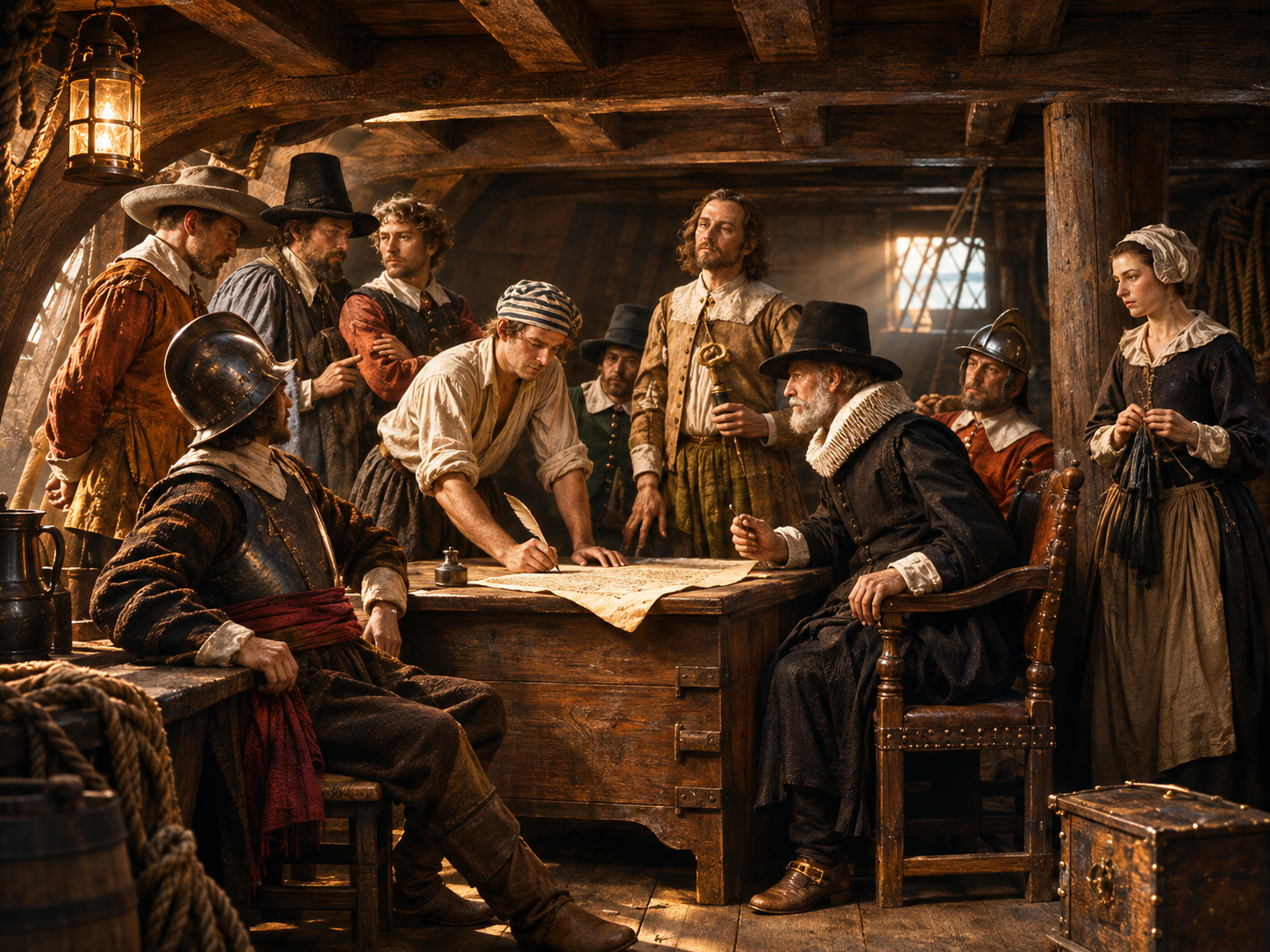
England, November 1620
In November 1620, a group of 102 passengers embarked from England on a ship called the Mayflower on a dangerous voyage across the Atlantic Ocean. They originally intended to land at the mount of the Hudson River, which is currently in the New York City area. England claimed that area as Virgina, under the Virginia Company's charter. Dangerous shoals forced them back when they tried to reach the Hudson River. Eventually, they ended up in Cape Cod Bay on the shore of what would become Plymouth Colony, and later, Plymouth, Massachusetts.
Of the passengers, there were Puritan Separatists, tradesmen, laborers, and an additional 20-30 ship crew. The Puritans were leaving England because they believed that the government of England had corrupted the Church of England and the Separatist Puritans who did not want to attend the Church of England were being persecuted.
When the righteous are in authority, the people rejoice; but when a wicked man rules, the people groan. Proverbs 29:2
According to the Act of Uniformity (1559) missing certain services at the Church of England, including Sunday services, could result in fines, even fines leading to imprisonment. A few years later, the Seditious Sectaries Act (1592) raised the consequences, especially for Puritan Separatists.
The Seditious Sectaries Act could be used to arrest, imprison, and even execution. This Act was used to later imprison the writer John Bunyan in 1661. It also was the Act used for the execution of Henry Barrow (1593), John Greenwood (1593), and John Penry (1593). All three of these men were Separatists who didn’t agree with the Church of England during these years.
It was amid these dangerous years for anyone who opposed the Church of England that this small group of Puritans hired the Mayflower and set sail for New England. They had a desire to openly practice their worship towards the Lord and a new continent with fresh start was their best choice.
Cape Cod Bay, December 1620
When they finally arrived at Cape Cod Bay in late December, 1620, the leaders aboard the Mayflower decided to draft the following, now known as the Mayflower Compact:
Agreement Between the Settlers at New Plymouth: 1620
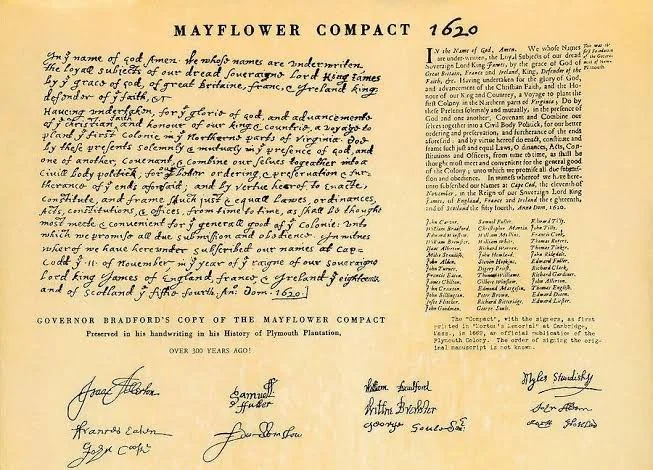
Mayflower Compact (1620) — A humble covenant of faith and order: pilgrims binding themselves “for the general good” under God’s guidance to establish just laws and mutual care in a new land.
IN THE NAME OF GOD, AMEN. We, whose names are underwritten, the Loyal Subjects of our dread Sovereign Lord King James, by the Grace of God, of Great Britain, France, and Ireland, King, Defender of the Faith, &c. Having undertaken for the Glory of God, and Advancement of the Christian Faith, and the Honour of our King and Country, a Voyage to plant the first Colony in the northern Parts of Virginia; Do by these Presents, solemnly and mutually, in the Presence of God and one another, covenant and combine ourselves together into a civil Body Politick, for our better Ordering and Preservation, and Furtherance of the Ends aforesaid: And by Virtue hereof do enact, constitute, and frame, such just and equal Laws, Ordinances, Acts, Constitutions, and Officers, from time to time, as shall be thought most meet and convenient for the general Good of the Colony; unto which we promise all due Submission and Obedience.
IN WITNESS whereof we have hereunto subscribed our names at Cape-Cod the eleventh of November, in the Reign of our Sovereign Lord King James, of England, France, and Ireland, the eighteenth, and of Scotland the fifty-fourth, Anno Domini; 1620.or
Signed By: John Carver, William Bradford, Edward Winslow, William Brewster, Isaac Allerton, Myles Standish, John Alden, John Turner, Francis Eaton, James Chilton, John Craxton, John Billington, Moses Fletcher, John Goodman, Samuel Fuller, Christopher Martin, William Mullins, William White, Richard Warren, John Howland, Stephen Hopkins, Digery Priest, Thomas Williams, Gilbert Winslow, Edmund Margesson, Peter Brown, Richard Britteridge, George Soule, Edward Tilly, John Tilly, Francis Cooke, Thomas Rogers, Thomas Tinker, John Ridgdale, Edward Fuller, Richard Clark, Richard Gardiner, Mr. John Allerton, Thomas English, Edward Doten, Edward Liester
God’s Ordinance
The Mayflower Compact was drawn up and signed as the first formal act of the Puritans in New England. Since they had intended to land in area settled under the Virginia Company’s charter, they were now in an area at Cape Cod that was outside the bounds of their original patent. The settlers needed an official form of agreement before disembarking their ship.
Remind them to be subject to rulers and authorities, to obey, and to be ready for every good work, to speak evil of no one, to be peaceable, gentle, showing all humility to all men. Titus 3:1
They had been advised and encouraged by their pastor back in Leiden, Holland, John Robinson, on how to pick godly leaders who would lead them well in their new country. “Lastly, whereas you are become a body politic, using amongst yourselves civil government, and are not furnished with any persons of special eminency above the rest, to be chosen by you into office of government; let your wisdom and godliness appear, not only in choosing such persons as do entirely love and will promote the common good, but also in yielding unto them all due honor and obedience in their lawful administrations, not beholding in them the ordinariness of their persons, but God's ordinance for your good.” From John Robinson’s Farewell Letter.
John made sure that the Puritans were reminded that they were entering a situation where there was no overseeing government, and that they would be the ones choosing the offices of government. He encouraged them to let their wisdom and godliness lead in picking the leaders that would be set up in their community, but also to use their wisdom and godliness in giving due honor to their leaders and obedience to their lawful administrations.
Warning Against Self-Love
The Puritans had survived dangers and death on the ocean, but now they were under threat of falling apart under the hardship of starting a new life in an unsettled land.
One of the local pastors in Plymouth, Robert Cushman, warned his congregation about the sin of self-love in a sermon. Written in December 1621, Robert encourages anyone who is willing to spend their time and labor, and endure hardships, to come to New England for the furtherance of the Gospel and the providence that God was showing on those who endured.
“… but if there be any who are content to lay out their estates, spend their time, labors, and endeavors, for the benefit of them that shall come after, and in desire to further the gospel … quietly contenting themselves with such hardship and difficulties, as by God’s Providence shall fall upon them, being yet young, and in their strength, such men I would advise and encourage to go, for their ends cannot fail them.”
Therefore, my beloved brethren, be steadfast, immovable, always abounding in the work of the Lord, knowing that your labor is not in vain in the Lord. 1 Corinthains 15:58
While Robert encouraged those who would endure, he also warned against those men who were looking for easy riches. “That for men which have a large heart, and look after great riches, ease, pleasures, dainties, and jollity in this world (except they will live by other men’s sweat, or have great riches) I would not advise them to come there, for as yet the country will afford no such matters.” The Sin and Danger of Self-Love described in a sermon by Robert Cushman, Plymouth, New England, 1621.
But if anyone does not provide for his own, and especially for those of his own household, he has denied the faith and is worse than an unbeliever. 1 Timothy 5:8
Thank God Who Hath Dealt Favorably
A time to be born, and a time to die; a time to plant, and a time to pluck up that which is planted. Ecclesiastes 3:2
It is inspiring to see the result of those men, women, and children who did endure, and struggle through the hardships of their new home. In a classic account by one of the signers of the Mayflower Compact, Edward Winslow, described how the Pilgrims had learned how live in the terrain of New England.
After death, struggles for food, cold, weather, they had made friends with the local Native Americans and learned how to grow food in the unfamiliar land. Now, after a year of living in Plymouth, Edward described the abundance that they had found and gave thanks to God. This is an excerpt from a letter he wrote on December 11, 1621.
“These things I thought good to let you understand, being the truth of things as near as I could experimentally take knowledge of, and that you might on our behalf give God thanks who hath dealt so favorably with us.”
“I never in my life remember a more seasonable year, than we have here enjoyed: and if we have once but kine, horses, and sheep, I make no question, but men might live as contented here as in any part of the world. For fish and fowl, we have great abundance, fresh cod in the summer is but coarse meat with us, our bay is full of lobsters all the summer, and affordeth variety of other fish; in September we can take a hogshead of eels in a night, with small labor, and can dig them out of their beds, all the winter we have mussels and othus at our doors: oysters we have none near, but we can have them brought by the Indians when we will; all the springtime the earth sendeth forth naturally very good sallet herbs: here are grapes, white and red, and very sweet and strong also. Strawberries, gooseberries, raspas, etc.” Letter of Edward Winslow, December 11, 1621.
If you’d like to learn more about early American history and what our nation was founded on, you can pre-order The American Story documentary from Real Life Network with Tim Barton and Jack Hibbs. Watch the offical trailer below.
Thank you for reading! If this story inspired you, we invite you to partner with us in continuing the ministry God started over 27 years ago. We appreciate your prayerful consideration in joining us to reach more souls for Jesus.
© 2026 Calvary Chapel Magazine (CCM). All rights reserved. Articles or photographs may not be reproduced without the written permission of CCM. All Scripture quotations, unless otherwise indicated, are taken from the New King James Version. Copyright © 1982 by Thomas Nelson, Inc.® Used by permission.